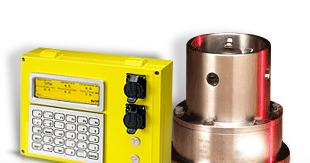
During drilling and logging operation depth is a critical parameter measured in the oilfield. Depth of a wireline logging tool, the drilling depth, or the depth of Coiled Tubing in the well are all usually measured by means of a depth encoder.
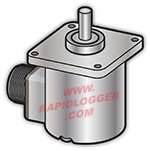
The depth encoder is usually a small cylindrical device with a shaft on one end. The shaft is generally fixed to a wheel or sprocket axle such that the encoder shaft rotates with the wheel.
Each rotation of the encoder shaft can be accurately measured by means of a perforated disk installed inside the encoder. A small light beam shines on one side of the perforated disk. As the disk rotates a series of light and dark pulses appear on the other side of the disk as the perforations pass in front of the light. The pulses are sensed by a light sensor and counted to determine the exact total and fractional rotations of the shaft. In this manner an encoder utilizes two light sensors that are set apart from each other. The second light sensor allows the encoder to also sense the direction of rotation of the disk. Depth encoder signals can be input directly in to the Rapidlogger System, recorded, displayed, and reported. The Rapidlogger system can also easily calculate speed from the depth values.
Optical Encoders: Use LED light sources and photodetectors to sense a patterned disk rotating with the shaft. The disk contains radial slits that alternately block and pass light. Two sets of detectors positioned 90 degrees apart provide quadrature output signals, enabling direction sensing and 4x resolution multiplication. Optical encoders are the most common type in oilfield applications due to their reliability and accuracy.
Magnetic Encoders: Employ magnetized patterns on a rotating disk and Hall effect sensors or magnetoresistive elements to detect position. Magnetic encoders offer superior resistance to contamination from oil, dust, and vibration compared to optical types. They are ideal for harsh oilfield environments where sealing is difficult.
Incremental vs. Absolute Encoders: Incremental encoders generate a pulse for each increment of rotation and require a reference point to establish absolute position. Absolute encoders provide unique position information for each shaft angle, eliminating the need for homing after power loss. Most oilfield depth measurement uses incremental encoders with software-based position tracking.
Resolution: Encoder resolution is specified in pulses per revolution (PPR) or cycles per revolution (CPR). Common resolutions range from 100 PPR to 10,000 PPR. Higher resolution provides finer depth measurement but requires faster counting electronics. Quadrature decoding multiplies effective resolution by 4x (e.g., 1,000 CPR becomes 4,000 counts per revolution).
Measuring Wheel Diameter: Depth accuracy depends on the measuring wheel circumference. Common wheel diameters include 12 inches, 18 inches, and 24 inches. Larger wheels provide better accuracy by averaging cable irregularities but require more space. Wheel circumference must be calibrated to account for cable stretching and wear.
Depth Accuracy: Overall depth accuracy depends on encoder resolution, wheel diameter, and mechanical factors. Typical systems achieve ±0.1 feet per 1,000 feet of depth under ideal conditions. Cable stretch, wheel slippage, and temperature effects can degrade accuracy to ±0.5 feet per 1,000 feet.
Speed Capability: Encoders must handle maximum line speeds without missing counts. Standard encoders operate up to 6,000 RPM. At typical wireline speeds of 10,000 feet per hour with an 18-inch wheel, the encoder rotates at approximately 350 RPM, well within normal operating range.
Output Signals: Standard outputs include differential line driver (RS-422), open collector, push-pull, and TTL-compatible signals. Differential outputs provide superior noise immunity for long cable runs common in oilfield installations. Some encoders offer SSI (Synchronous Serial Interface) or analog 4-20 mA outputs.
Wireline Logging: Depth encoders mounted on the wireline sheave wheel track tool position during logging runs. Accurate depth correlation is essential for formation evaluation and well planning. Dual encoders are often used for redundancy and verification. Depth data is synchronized with logging sensor measurements to create accurate formation logs.
Drilling Operations: Rotary encoders on the drawworks measure drillstring depth. Block position encoders track hook height and bit depth. Accurate depth measurement is critical for geosteering, formation tops identification, and wellbore placement in horizontal drilling.
Coiled Tubing: Depth measurement during coiled tubing operations uses encoders on the injector head or guide arch wheels. Precise depth tracking enables accurate tool placement for perforating, stimulation, and cleanout operations. Depth accuracy affects treatment zone placement and operational efficiency.
Slickline Operations: Encoders measure cable depth during slickline well intervention. Depth accuracy is critical for setting plugs, running gauges, and operating downhole tools at precise depths. Surface readout units display real-time depth and speed to the operator.
Snubbing and Workover: Hydraulic workover units use depth encoders to monitor pipe position during tripping operations. Depth tracking helps identify formation tops, casing collars, and stuck pipe locations.
Mounting and Alignment: Mount encoders with rigid mounting brackets to prevent vibration and misalignment. Use flexible couplings or direct shaft mounting depending on application. Ensure encoder shaft is parallel to the measuring wheel axle to prevent side loading. Use shaft guards to protect the encoder from cable wrap damage.
Measuring Wheel Configuration: Install measuring wheels with proper cable wrap angle (typically 120-180 degrees) to prevent slippage. Maintain constant pressure on the cable using spring-loaded or weighted wheel assemblies. Use grooved wheels matched to cable diameter. Clean wheels regularly to prevent buildup that affects effective diameter.
Cable Stretch Compensation: Account for cable stretch due to tool weight and temperature. Heavy tool strings can stretch wireline cable by 0.5% to 2% of depth. Apply stretch correction factors based on cable specifications, tool weight, and depth. Some systems use dual measurement (top and bottom) to calculate real-time stretch.
Environmental Protection: Use NEMA 4X or IP67 rated encoders for outdoor oilfield installations. Install sunshields and protective enclosures to prevent direct sunlight and weather exposure. Maintain operating temperature within encoder specifications (typically -40°F to +185°F). Consider heating elements for cold climate operations.
Calibration Procedures: Perform calibration using certified steel tape or calibrated depth reference. Measure actual distance traveled and compare to encoder counts. Calculate wheel circumference correction factor. Typical calibration involves running cable for 100 or 1,000 feet and adjusting the circumference setting to match actual distance.
Zero Depth Reference: Establish depth zero reference at derrick floor, rotary table, or ground level depending on operational requirements. Document zero reference location and elevation for accurate depth correlation. Reset depth counter at the beginning of each logging run or operation.
Regular Verification: Verify depth accuracy by comparing pipe tally, casing collars, or known formation tops. Check for wheel slippage during high-speed or heavy-load operations. Inspect cables for excessive wear that changes effective diameter. Recalibrate monthly or after cable replacement.
API RP 45: Recommended Practice for Analysis of Oilfield Waters provides guidance on sample depth requirements and depth measurement accuracy for fluid sampling operations.
API Specification 7K: Specification for Drilling and Well Servicing Equipment includes requirements for drawworks depth indicators and accuracy standards for drilling depth measurement.
SPWLA (Society of Petrophysicists and Well Log Analysts): Provides standards for well log depth measurement and correlation. Recommends minimum depth accuracy of ±2 feet for formation evaluation logging.
ISO 10426: Petroleum and natural gas industries - Cements and materials for well cementing includes depth measurement requirements for cement job documentation and verification.
NACE SP0196: Standard Practice for Detection, Repair, and Mitigation of Cracking of Existing Petroleum Refinery Pressure Vessels in Wet H2S Environments requires accurate depth documentation for inspection and repair activities.
Encoder Standards: Encoders should comply with IEC 61000 for electromagnetic compatibility. Hazardous area encoders must meet ATEX, IECEx, or FM/CSA standards for Class I, Division 1/Zone 0 applications.
Calibration Traceability: Depth calibration standards should be traceable to NIST length standards. Maintain calibration records documenting wheel circumference, correction factors, and verification measurements. Annual recertification is recommended for critical applications.